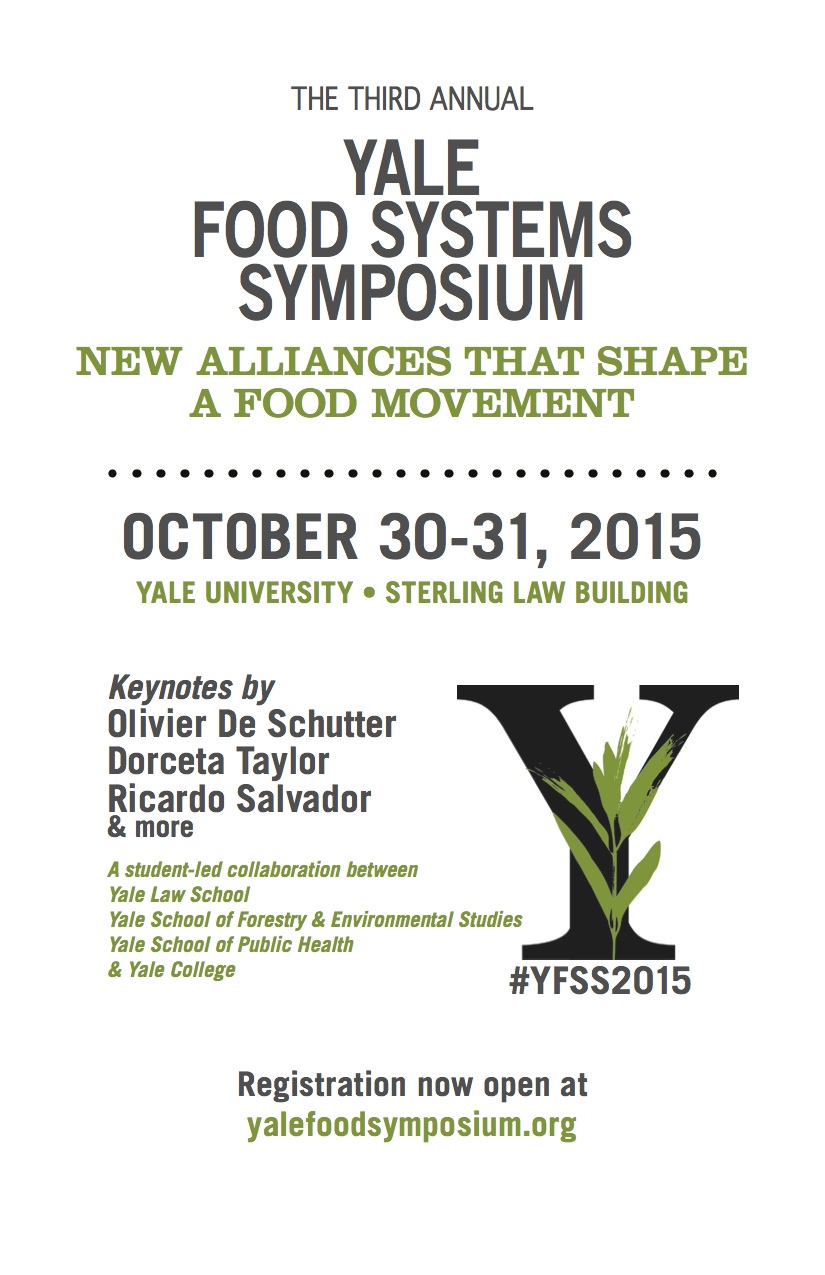
3rd Annual Yale Food Systems Symposium: New Alliances That Shape A Food Movement

2015 Yale Food Systems Symposium

Registration is now open for the third annual Yale Food Systems Symposium: a student-led collaboration between Yale Law School, Yale School of Forestry & Environmental Studies, Yale School of Public Health, and Yale College.

This year’s conference, “New Alliances That Shape a Food Movement,” will be held on October 30th & 31st, and feature keynote addresses from Olivier De Schutter, Dorceta Taylor, and Ricardo Salvador.

  • Who: Open to academics, practitioners, students, and interested members of the public
  • Date: Friday October 30th & Saturday October 31st
  • Location: Yale Law School, Sterling Law Building – New Haven, CT
  • Fee: You must register to attend, but tickets are only $30 (or free for current Yale students) and include two meals: dinner Friday and lunch Saturday.

Register here!

Milan’s Urban Food Policy Pact

On World Food Day on October 16th Mayors from 46 cities around the world will sign on to Milan’s Urban Food Policy Pact. Work on the Pact by international experts, the European Union and United Nations began in 2014 to craft the proposal. The pact focuses on equitable and sustainable food systems and includes goals to “develop sustainable dietary guidelines”, “encourage and support social and solidarity economy activities”, “help provide services to food producers in and around cities”, “support short food chains” and “raise awareness of food loss and waste”. Click here to find out more about the pact and which cities will sign on.

Should We Still Be Talking About Food Deserts?

By now, you’ve probably heard about food deserts.  Maybe as part of the First Lady’s Let’s Move! Campaign to end childhood obesity.  Maybe your state has established a task force to investigate food accessibility.  Perhaps you’ve even mapped a food desert in your own town or city, using tools like the USDA’s Food Environment Atlas.  Though the term “food desert” can mean a variety of things, generally speaking, it refers to places with limited proximity to supermarkets and low rates of vehicle ownership, thus making a simple shopping trip more difficult than in better-served areas.  In many cities, the term also describes distinct racial and income disparities in terms supermarket access.  
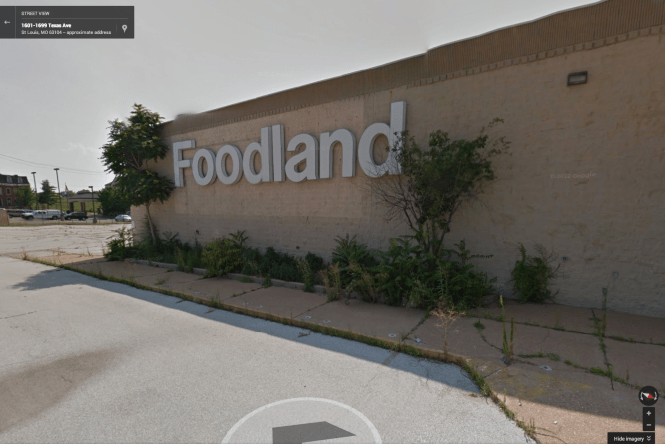
Foodland

The term “food desert” isn’t without its own problems.  First, and perhaps most importantly, this neighborhood-based concept doesn’t reflect how people actually live: many shoppers travel beyond the store closest to home, and this includes low-income and limited-mobility households.  By drawing lines around an area (typically using administrative boundaries, like Census tracts), we’re dramatically abstracting the notion of access.

Another issue is that the desert metaphor adopts a deficit orientation.  It’s possible that a neighborhood has a thriving urban garden system, or a robust network of curbside produce vendors, but no supermarket.  By naming a place a food desert, we might overlook or obscure important community food assets.  

Finally, the food desert concept assumes a specific problem and solution: supermarkets are lacking, and should be developed.  Among the many ways to bring healthy, fresh foods to areas without retailers, supermarket development is a large, expensive, and complicated endeavor. To this end, local, state, and federal actors have designed incentive packages to make these projects happen (check out the Heathy Food Access Portal for a variety of examples).

Nevertheless, as a planning researcher, I find some utility in the term.  Many low-income households want to shop at supermarkets, just as higher-income people.  Alternative models, such as farmers’ markets, cooperative groceries, and urban agriculture may all play a role (or, more likely, many roles) in terms of food access, mental and physical wellness, and community development.  Yet, they are hardly a replacement for the supermarket model that most American households use without issue.  The food desert concept can focus attention, and more importantly political, social, and economic capital, to one type of community development.

Indeed, supermarkets are major vehicle of the industrial food system; in many cases, they are also what low-income communities ask for.  This is worth much further exploration, but I offer it here to suggest that these dynamics aren’t straightforward or simple.

Now that I’ve punted on this major philosophical issue, let me offer a couple immediate research questions.  Many supermarket projects already completed, and more in the pipeline, so it makes sense for planning researchers to take stock of these developments and describe their effects.

  • When a new supermarket opens, do smaller stores close?  This is often the fear, and sometimes the case.  If so, what is the impact of these closures, both in terms of economic and social outcomes?
  • This isn’t the first time planners have advocated for supermarkets as elements of downtown revitalization.  What lessons have we learned (or should we learn) from history?
  • What are some of the “false positives” that result from the food desert definition?  For instance, where are places we call food deserts, but, in fact, are not?  Is this because a network of smaller stores effectively fills in?  Do few people actually live there?
  • Alternatively, what about “false negatives?”  Are there areas with supermarkets that are still poorly served?  Is the quality of a neighborhood supermarket so bad that nobody considers it a viable option?  Or, more provocative: how much does access matter when shoppers are poor (i.e. isn’t this just a poverty issue)?


Ben Chrisinger, PhD MUEP, is a postdoctoral research fellow at Stanford University’s Prevention Research Center and a member of APA-FIG’s Research Working Group.  You can follow him on Twitter, @benchrisinger.

 

Job: Food System Coordinator, Parks & Rec (Victoria, BC)

The City of Victoria, BC is hiring a Food System Coordinator:

“Victoria is a leading edge capital city that embraces the future and builds on the past, where human well-being and the environment are priorities and where the community feels valued, heard and understood. The City of Victoria is currently recruiting for a Food System Coordinator, a position best suited for a solutions-oriented professional with experience in food policy and sustainable food systems issues in a municipal setting, and who thrives in a high-paced work environment full of variety and opportunity. Our ideal candidate is a strong relationship builder, proud to represent the City and work proactively with others. If you are a team player, a proven problem solver and you are passionate about the community and what you do – we would like to hear from you! ”

For more information, click here.

Atlanta Seeks Urban Ag Director

DSC_0013

Anyone interested in an exciting new job? The City of Atlanta, Georgia, recently announced their search for a Director of Urban Agriculture. Applications are due September 15. Among a number of duties, this position will: “Coordinate with various City of Atlanta Departments to streamline procedures for the creation and support of urban agriculture in the city, including improving access for growers to public and private lands, facilitating the permitting process, obtaining necessary zoning permits, code compliance, brownfields conversion and other issues related to advancing urban agriculture in Atlanta.” To find out more and learn how to apply, click here.

What is APA-FIG all about?

At this spring’s annual APA-FIG meeting held at the APA National Conference in Seattle, this question was posed several times by the 25-plus participants in the room. The annual meeting’s agenda was focused on reviewing and providing feedback for the workplans of the four working groups (Policy, Education, Communication and Outreach, and Research) that were just launched the beginning of 2015. It became clear in discussing the goals and action items for each group over the coming year that APA-FIG needed to clarify the group’s overall purpose.

APA-FIG Leadership Team took the question to heart and dedicated time discussing the interest group’s mission and key goals. The mission of FIG is to help build stronger, more sustainable, just, equitable, self-reliant, and resilient community and regional food systems that, through planning practice, are integrated with other community systems, for present and future generations. Our overarching goals are to 1) support the advancement of food systems planning and 2) Strengthen the profession of food systems planning. For more details, click here.

We feel the mission and goals reflect the group’s purpose and will provide guidance in our efforts moving forward. We’re excited for the work and opportunities in the coming year as we continue to build the network. If you’re interested in joining FIG and getting involved with one of our working groups, let us know!

North American Map of Food Policy Councils

The Center for a Livable Future at Johns Hopkins University recently released an interactive map of food policy councils across the United States and Canada. For more information, click here or on the map below.

FPCMap

Exploring Stories of Innovation: Local Government Food Systems Planning and Policy

Growing Food Connections announced Exploring Stories of Innovation, a series of short articles that explore how local governments from across the United States are strengthening their community’s food system through planning and policy.

Beginning in 2012, Growing Food Connections (GFC) conducted a national scan and identified 299 local governments across the United States that are developing and implementing a range of innovative plans, public programs, regulations, laws, financial investments and other policies to strengthen the food system. GFC conducted exploratory telephone interviews with 20 of these local governments. This series will highlight some of the unique planning and policy strategies used by these urban and rural local governments to enhance community food security while ensuring sustainable and economically viable agriculture and food production. The first four articles in the series feature Seattle, WA; Baltimore, MD; Cabarrus County, NC; and Lancaster County, PA.

For more information and to download these free articles, visit http://growingfoodconnections.org/research/communities-of-innovation/.

Growing Food Connections is made possible with a grant from the USDA /NIFA AFRI Food Systems Program NIFA Award #2012-68004-19894. Partners include American Farmland Trust, American Planning Association, Cultivating Healthy Places, Ohio State University, and University at Buffalo.

Alaska: State Bill Proposes Eliminating Obstacles to Donation of Local Food

The Alaska Legislature is considering a bill that will eliminate obstacles to donating local food (fish, game, plants and eggs) to senior centers, child care facilities, schools, and other institutions.

“Caribou instead of corn dogs … salmon instead of Trout Treasures … seal meat in place of spaghetti — all could soon be available to more Alaskans if traction continues on a new bipartisan bill before the Alaska Legislature. House Bill 179 allows schools, senior centers, hospitals, child care centers and other facilities to accept and serve fish, game, plants and eggs that are donated by subsistence and sport users. Currently, state laws intended to prevent the commercial sale of wild game make the practice illegal if a program accepting food donations charges for the meal at any point before it is consumed. This means schools and senior centers, for example, are unable to provide meals containing subsistence- or sport-caught wild food if they accept any payment, including from federal or state meal programs…”

To view the full article, click here.

Update: Food Systems Planning Related Events, Sessions & Workshops at the APA National Planning Conference

FoodSystemsPlanningActivities_Seattle2015In early March, the APA-FIG Communication and Outreach Working Group compiled a list of food systems planning related events, sessions & workshops at the upcoming APA National Planning Conference in Seattle, WA this April 18-21, 2015 at the Washington State Convention Center. APA just released a handout highlighting many of these and providing detailed location information.

For more information, click on the image to the left.