Faces of Food Systems Planning: Andrea Petzel

APetzel.jpgAndrea Petzel, AICP, is the principal of Broadview Planning, a women-owned consulting firm specializing in community planning and public engagement. Before founding Broadview Planning in 2014, Andrea was a project manager and senior urban planner for the City of Seattle. During her time at the City of Seattle, Andrea led the legislative process for the city’s Urban Agriculture Ordinance, one of the nation’s first comprehensive urban agriculture ordinances aimed at removing barriers to growing and producing local food. In 2016, Andrea made the shift from policy to practice by starting her own backyard urban farm, Alouette Acres.

Andrea serves on APA-FIG’s Leadership Committee and was interviewed by Valerie Pacino on February 28, 2017.

How long have you been in this position? I founded Broadview Planning three years ago after leaving a position with the City of Seattle’s Office of Sustainability and Environment. While I was at the City of Seattle, I was lucky to work on a wide range of policy projects, from food systems and health impact assessments to energy efficiency and workforce development. When I left, I was eager to find a new opportunity to continue to work on a wide range of policy and public process projects. I quickly realized consulting was the best fit for my skills and interests, and so I created that role for myself by starting my own firm.

Do you consider yourself a food systems planner? No, I consider myself a traditional land use planner, but I seek out projects at the nexus of health, sustainability, and the built environment. I’ve been really lucky to work on some exciting food systems work, but I wouldn’t say I’m a food systems planner.

How did you get involved in food systems planning? Through my work on the City of Seattle’s Urban Agriculture ordinance, the goal of which was to reduce code barriers to growing and selling food in city. Through the policy development process, I was introduced to a great network of food systems planners, academics, urban farmers, and non-profit organizations all working towards a shared goal of increasing access to local grown, healthy food. It was a really exciting project, because at the time no other city had legislated a comprehensive approach to allowing urban agriculture in the city. It was thrilling to lead such a creative and collaborative policy development process that laid the groundwork for a much larger conversation about health and planning at the City of Seattle. The success of the Urban Agriculture ordinance led us to pursing federal funding to develop Seattle’s Healthy Living Assessment (HLA), a framework to assess health impacts at the neighborhood level. We worked to create clear, measurable metrics to assess community health at the neighborhood level using data that was easy to access, and readily used by community members in order to track progress toward health outcomes. The project was awarded a 2013 National Planning Achievement Award for a Best Practice from APA.

What do you enjoy about your work? The range of projects I get to work on brings me joy, and I thrive on bringing a health and food systems perspective to new clients and projects. I also love learning new things and thinking through new ideas, so I launched my own urban farm endeavor, and watching how policy translates into the real-life practice of growing and selling food is fascinating.

What do you find challenging about your work? Definitely getting people to make the link between food systems and the built environment. Also getting policy makers to embrace genuine community engagement in order to understand the very real challenges of people doing the work they’re trying to legislate.

Any advice to people who want to work in food systems planning? I believe a solid grounding in traditional land use planning is essential. Find a network of people doing the work you’re interested in and engage with them however you can – be curious, persistent, and helpful. Join APA-FIG! Also, find out what’s happen in your community and get involved with local projects.


Faces of Food Systems Planning is a series of interviews with practicing planners from across North America who are engaging in food systems planning and policy work. This series is part of APA-FIG’s efforts to highlight food systems planning as an important planning topic. The APA will be featuring 8 food system planners at the National Planning Conference this May 2017 in a special “Faces of Food Systems Planning Session”. Click here for more information.

Faces of Food Systems Planning: Ben Kerrick

Ben Kerrick head shotBen Kerrick has been a consultant with Karen Karp & Partners in New York City for nearly three years. Ben has a wide range of life experiences and technical expertise, all of which he brings to bear on his work as a food systems planner. With nationally renowned food system consultant Karen Karp, Ben co-hosted the 2015 Heritage Radio Network podcast series, How Great Cities Are Fed. Inspired by W.P. Hedden’s 1929 book of the same name, Karen and Ben examine food systems in historical and contemporary terms through topics such as refrigeration, foodsheds, transportation, and “the middlemen.” Karen and Ben are joined by guest experts and friends from the food sector as they delve into the issues and hidden workings of how our great cities are fed.

This interview was conducted via email on July 5, 2016, and was edited by Marcia Caton Campbell. She highly recommends binge listening to How Great Cities are Fed on your favorite podcast subscription service.

What do you enjoy about your work? We work all across the food chain, and as consultants our work is project-based, so there’s a tremendous variety and dynamism to the work – no two days are the same. So far this year my work has included designing a kitchen and café program for a social services non-profit, assessing a food bank supply chain, developing a concept for a new food education hub in a small town, and researching feasibility and market demand for a new slaughterhouse in Michigan’s Upper Peninsula. So it’s really engaging, and we often get to see the way our work impacts organizations and people in tangible ways. I also get to make maps and other data visuals fairly often, which I get a big kick out of. And, you know, I love to eat, so I feel pretty lucky that I get to talk and think about food every day.

My background is in the arts – I have a degree in theater, and I spent five years working for a New York City arts non-profit – so I also enjoy being able to draw on that experience whenever I can, whether in our event design projects, or by engaging with artists and designers whose work deals with issues of food, agriculture, and sustainability.

Similarly, what do you find challenging about your work? There’s so much to learn. Food systems are so complex – I sometimes feel overwhelmed by how much I don’t know. But that’s also what keeps it exciting and interesting, and I learn something new every day and with every project. I ask a lot of questions.

Another challenging and engaging dimension of food systems work is that food is so fundamental to daily life – we all eat, everyday – so people have strong personal feelings and opinions about food, and the stakes often feel high. But that also convinces me that this work matters. And it’s rewarding when you can work with a diverse group of stakeholders to find some new solution to a gap in the food system.

What areas of the food system do you focus on in your work? As I mentioned, we work all along the food chain. I’m the only one trained as a planner on staff, so I do tend to work on the more “planner-y” projects – community or regional food assessments, economic development through food business, things like that. I’ve also done food access-oriented work with food banks and social services organizations. We do event design and facilitation for food-related events (such as the James Beard Foundation Food Conference), and with my background in theater and the arts, I work on those as well. Others in our company focus on different areas, like culinary education, supply chain analysis, and program design and evaluation (though much of my work touches those things too).

In the work that you perform, where does addressing food systems issues fit in? How has this changed over time? I don’t think it’s a stretch to say that most or all of the work I do addresses food systems issues. It just depends on the lens you’re using, and how explicit it is. Sometimes it’s a community saying, “Research and assess our food system, identify issues and needs, and help us find opportunities for improving it.” Other times it’s an independent entity like a non-profit or business doing something that touches food, and we’re working on some narrow component of it – but even in that case, the first thing we do is always to contextualize that program within the larger food system.

Do you consider yourself a food systems planner? Why or why not? Absolutely. All of my work relates to food systems planning in some way.

How has your perception of food systems planning changed since you first entered the planning field? I came to the broader field of planning by way of food systems planning – not vice versa. I went to graduate school knowing I wanted to study food systems, and did dual Master’s degrees in Environmental Science and City & Regional Planning. So I entered the urban planning world sort of thinking everyone else would be as excited about food systems as I am, which needless to say wasn’t exactly the case. But I was lucky that there were some great food systems-oriented opportunities in my planning program, and I’ve been very lucky to continue that trajectory into my current work.

But I think food systems planning is still kind of a blip in the larger world of planning. In most contexts, when I’m talking to someone new, I have to explain what food systems planning is – the phrase alone usually elicits blank stares. I go to a monthly happy hour with LGBT urban planners, and even people I meet there – practicing urban planners! – don’t usually know about food systems planning as a field and discipline. I experience the same thing at the APA conference. That all being said, I do think there’s more and more food systems planning happening out there, and I think it will continue to grow.

Who has had the most influence on you as a planner? As a food systems planner? Dr. Casey Hoy was my advisor at Ohio State University – and after I graduated I managed the Agroecosystems Management Program that he directs. He really instilled in me a willingness to not shy away from areas of daunting complexity in food systems research, and a deep commitment to robust, rigorous data analysis – and the ability to communicate that analysis clearly and effectively. Casey is great at getting a diverse group of stakeholders to the table and “translating” between the different languages that, say, farmers, academics, policymakers, and businesspeople use. That skill is crucial to successful food systems work, and I try to get better at it with every project. If the people you bring to the table all speak the same language, you’re probably not trying hard enough to get diverse voices into the conversation.

And now I have the pleasure of working with an outstanding staff at KK&P – we all bring something different to the table and I learn from each of them every day. Karen Karp has been doing this work for over 25 years, so she was really early on the scene of food systems work (though I’m not sure that phrase would have been used then). My background is firmly in the non-profit/public service/academic world, whereas Karen came to this work through restaurant and business consulting. So working with Karen has really broadened my knowledge and toolkit in terms of working with food businesses and entrepreneurs to create a more resilient food system. Karen, like Casey, is also a really skilled facilitator of diverse stakeholder groups, so I learn a lot from her in how she approaches those conversations.

Do you have any advice for someone entering the food systems planning field? What skills do you use the most in your food systems planning related work? I think effective food systems planners need to be both generalists and specialists. So I would advise an aspiring food systems planner to get exposure to as much of the food system as possible – agriculture, processing, distribution, retail, institutional feeding, food access work, the list goes on – to build an understanding of how the pieces fit and relate to each other. And whenever a particular topic or area really catches your interest, dig deep to develop more specialized expertise. I wouldn’t say I’ve been especially strategic about picking my areas of expertise, but I’ve followed my interests and passions and that has served me well.

I also think effective stakeholder engagement and facilitation is absolutely foundational to successful food systems work that pursues sustainability, resilience, and equity. Keep asking, “Who’s not at the table? Whose voices are being left out of this conversation, and how can we include them?” I’ve never taken formal facilitation training, but it’s central to the work that we do, and I would highly recommend seeking training or opportunities for learning about stakeholder engagement and facilitation.


Faces of Food Systems Planning is a series of interviews with practicing planners from across North America who are engaging in food systems planning and policy work. This series is part of APA-FIG’s efforts to highlight food systems planning as an important planning topic. The APA will be featuring 8 food system planners at the National Planning Conference this May 2017 in a special “Faces of Food Systems Planning Session”. Click here for more information.

Faces of Food Systems Planning: Laine Cidlowski

LCidlowski.JPGLaine Cidlowski, AICP, LEED-AP is the Food Policy Director for the District of Columbia Office of Planning in Washington, DC. She was previously the Lead Urban Sustainability Planner for the Office of Planning where she was the project manager for the Office of Planning for the Sustainable DC initiative and Plan to make the city the healthiest, greenest, and most livable city in the United States. Prior to joining OP in March 2008, she worked as Planner-Urban Designer for the Maryland National Capital Parks and Planning Commission in Prince George’s County Planning Department. She holds a Masters Degree in City and Regional Planning – Certificate in Urban Design from the University of Pennsylvania and B.A. Degree from the University of North Carolina – Chapel Hill in Environmental Studies. Laine is a member of the American Institute of Certified Planners, and serves as a Co-Chair for APA-FIG.
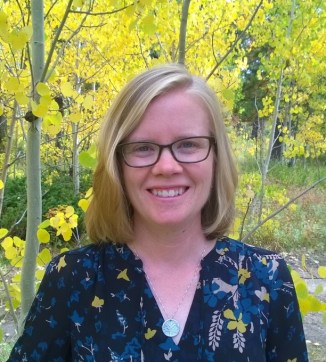
This interview was conducted via email in March 2017 by Megan Bucknum, member of the APA-FIG Leadership Committee.

What is your current position? District of Columbia Food Policy Director, DC Food Policy Council and DC Office of Planning

How long have you held this position? Around a year and a half

What do you enjoy about your work? I love working with so many committed and dedicated activists and community organizers from diverse areas of the food system. It is really inspiring to see their creativity and enthusiasm as they come up with new programs to help build and support our local food system. I feel really honored to be able to build on their work and scale-up solutions for healthy food access, urban agriculture, procurement, food justice, food businesses and more at the citywide level. My job entails different things every day, and I enjoy that variety.

Similarly, what do you find challenging about your work? First, the problems we face in food systems are deeply rooted in institutional racism, justice, and poverty. Although these cross-cutting systematic injustices are often the precursors to food justice programs, it’s important to understand that solving these problems cannot be done fully within food systems work. Prioritizing and focusing within such a vast field can also be a challenge, especially when there are so many different programs and organizations taking different tactics at how to approach the same issues.

What areas of the food system do you focus on in your work? Since I work at the citywide level, I work on a bit of everything. I coordinate for more than ten agencies of the District of Columbia who have responsibility over their respective part of our local food system, and also manage our Food Policy Council (FPC). Our FPC works on sustainable food procurement, food equity, food access, nutrition and health, food business, and urban agriculture issues.

In the work that you perform, where does addressing food systems issues fit in? How has this changed over time? Everywhere! This position was just created in 2015, so before I was hired, no one was looking at food issues systems wide.

Do you consider yourself a food systems planner? Why or why not? I’d say I do now, though my undergrad degree was in environmental studies, and my Masters in city planning and urban design. I worked my way to food systems through green infrastructure and sustainability, which I think are all interconnected, although my academic training did not focus on food systems.

What is the biggest food systems planning-related hurdle your community/ organization faced in recent years and how was it dealt with? Access to grocery stores in low-income communities is the toughest issue for us, and the most urgent to get a handle on. Residents in our wealthiest neighborhoods have one grocery store per 13,000 residents. In our poorest areas, it’s almost 1 per 70,000. Nothing is a higher priority for us than to get full-service grocery options in those areas.

How has your perception of food systems planning changed since you first entered the planning field?I’ve always thought of it as a city or regional level system, but the more and more I learn about the field, the more interested I am in the behavioral psychology aspect of the issue. So much is influenced not just but the built environment and community but also by the choices of individuals, corporations, governments, and communities. Individual and group choice has a huge impact on our food systems as a whole, so gaining a better understanding of how and why people make decisions around food will help us to take a much more nuanced approach to our work in the future.

Who has had the most influence on you as a planner? As a food systems planner? My prior boss, Harriet Tregoning had a huge influence on me. She taught me a lot about the power of being really strategic with your efforts at work, to use a combination of storytelling and data to persuade and work with decision-makers to make change in a community. She’s a really thoughtful and curious leader who always wanted to know the why and the detail of our efforts. She would encourage us to take risks, fail, and figure out how to quickly glean lessons from our failure and try again.

Do you have any advice for someone entering the food systems planning field? What makes you successful in your work? What skills do you use the most in your food systems planning related work? Don’t just send a blitz of copy and paste informational interview emails. So many young people are interested in this field right now, which is really wonderful; however I, and many of my colleagues get lots and lots of informational interview requests. The ones that get responses from me are the ones that are specific and provide some detail about why you’d like to talk to me specifically (i.e. you did a little research) rather than a blanket request.

Relationship building, making connections, and networking is almost as important as your work itself. If you have good relationships established, not associations based on needing something from someone, it is much easier to find common ground to work on a project or issue later. Those are skills that translate across many fields, but it is especially true for food systems.

What do you wish you would have known before going to planning school? Take a zoning class, a law class, a regulatory class and a negotiation class. Knowing and understanding the regulatory system can help you understand the context for your work. Learning the art of negotiation can help you better understand the needs/wants of the people you work with.


Faces of Food Systems Planning is a series of interviews with practicing planners from across North America who are engaging in food systems planning and policy work. This series is part of APA-FIG’s efforts to highlight food systems planning as an important planning topic. The APA will be featuring 8 food system planners at the National Planning Conference this May 2017 in a special “Faces of Food Systems Planning Session”. Click here for more information.

Faces of Food Systems Planning: Kara Martin

KaraMartin_headshot.jpg

Kara Martin recently became the Program Director for the Food Innovation Network (FIN) based in south King County, WA. Previously, Kara was a food systems planning consultant who worked independently since 2009. Based in Seattle, Kara works with communities to create equitable, vibrant places for people to lead healthy lives.

Kara serves on APA-FIG’s Leadership Committee and was interviewed by Andrea Petzel on January 26, 2017.

How long have you been in this position? I became the FIN Program Director in 2017- while the position is new, I worked as a consultant on the project for the past three years. Previously, I was owner/principal of Healthy Community Planning LLC, and I’ve worked as a consultant for food systems planning since 2009. After graduating with a master’s degree from the University of Washington in 2009 in the heart of the recession, I didn’t think a job would be waiting for me. Everybody was being laid off, and because of the focused work I did I was aware of some interesting funding opportunities and had the right relationships to make consulting for community food systems planning work right out of grad school.

How did you become a food systems planner? Before becoming a planner I did a lot of work around food security and hunger relief. During that time I read Sweet Charity by Janet Poppendieck, got halfway through it and got upset about the state of our food system here in Seattle. Working in downtown Seattle for a meal program, and seeing what life was like for people after hours, when businesses close their door, made me rethink my focus. I started making the connection between food systems, food access, and built environment, and ultimately ended up pursing a master’s degree in planning at the University of Washington’s College of the Built Environment, where I focused all my energy on food systems planning work.

What do you enjoy about your work? The range of projects I get to work on. Because it’s systems work I can work with food entrepreneurs, farmers, city planners, residents; a lot of people with people with different perspectives, which leads to a lot of innovative strategies and innovative thinking. I particularly enjoy community-ownership of food system efforts. FIN works with community food advocates, community leaders, who guide our strategy development and implementation while engaging their communities in the mission.

What do you find challenging about your work? I think getting people to understand the link between the food system and built environment. Food systems planners are often working in silos or in other fields of planning, which makes it challenging to move any goals or policies forward.

Do you consider yourself a food systems planner? Yes!

What areas of the food system do you focus on in your work? Two areas: community food access and economic development around the local food economy. I like to think of food as a community development strategy that’s not just about locally produced food. We need to better connect local food to the broader food economy and all communities.

In the work that you perform, where does addressing food systems issues fit in? How has this changed over time? In the beginning I spent almost three years working on a healthy food retail project. I don’t do that now, but now I work with a lot of food entrepreneurs, and my earlier work gave me a lot of credibility because I worked with small food retail businesses. I have the unique role of having one foot in the policy world, and the other in the “real” world, such as helping businesses get started and grow.

Any advice to people who want to work in food systems planning? Take any class, workshop, webinar you can – if it’s not food focused, find a way to make your projects and papers on food policy topics. Attend food policy council meetings, volunteer, and get to know your community and the work that’s happening on the ground.


Faces of Food Systems Planning is a series of interviews with practicing planners from across North America who are engaging in food systems planning and policy work. This series is part of APA-FIG’s efforts to highlight food systems planning as an important planning topic. The APA will be featuring 8 food system planners at the National Planning Conference this May 2017 in a special “Faces of Food Systems Planning Session”. Click here for more information.

APA FIG Reception in NYC

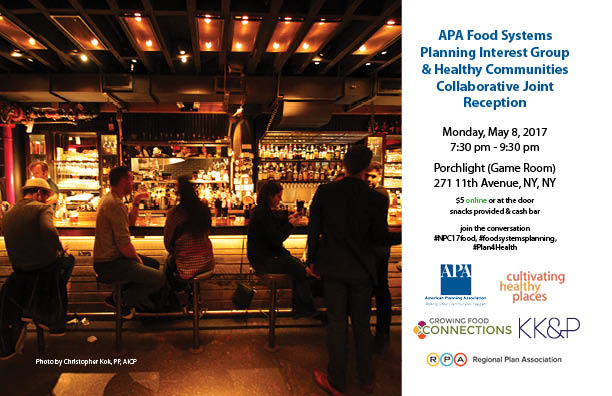
On behalf of the APA-FIG Leadership Committee, we would like to invite you to the annual networking reception in New York City on Monday, May 8, 2017. This year, we will be hosting a joint reception with the APA Healthy Communities Collaborative. We hope to see you in NYC!

APA-FIG-HCC_NPCReception2017

National Planning Conference NYC 2017

NYC-LIC

Don’t forget to register for one of the biggest National Planning Conferences! Registration rates increase starting March 3!

The APA-FIG Leadership Committee hopes to see you in New York City this May. Check out all the exciting food systems planning related events and sessions (16 in total!), including the APA-FIG Business Meeting and Annual Networking Reception. We look forward to seeing many of you at the conference!


Hudson Valley Local Agriculture and Foodshed | Friday, May 5, 2017 | 7 a.m. – 7 p.m. | https://www.planning.org/events/nationalconferenceactivity/9107838/

Gotham West Market, Housing & Community Development Division Lunch Reception | Saturday, May 6, 2017 | noon – 1 p.m. |  https://www.planning.org/events/nationalconferenceactivity/9116698/

Modern Food Hall: Redevelopment Aid or Trend | Saturday, May 6, 2017 | 1 p.m. – 2:15 p.m. | https://www.planning.org/events/nationalconferenceactivity/9107948/

Incentivizing the Sale of Healthy and Local Food | Saturday, May 6, 2017 | 2:30 p.m. – 3:45 p.m. | https://www.planning.org/events/nationalconferenceactivity/9109374/

City Food Policy Advisors Kick Plans into Action | Saturday, May 6, 2017 | 4 p.m. – 5:15 p.m. | https://www.planning.org/events/nationalconferenceactivity/9109407/

Food Systems Planning: Growing Connections and Planning for Health Across the Country | Sunday, May 7, 2017 | 9:30 a.m. – 10:45 a.m |  https://www.planning.org/events/nationalconferenceactivity/9109370/

The Resiliency of NYC Supply Chains | Sunday, May 7, 2017 | 9:30 a.m. – 10:45 a.m. | https://www.planning.org/events/nationalconferenceactivity/9107863/

Developing Vermont’s Food System through Planning | Sunday, May 7, 2017 | 2:30 p.m. – 3:45 p.m. | https://www.planning.org/events/nationalconferenceactivity/9110279/

Safe, Active Routes to Healthy Food | Monday, May 8, 2017 | 9 a.m. – 10:15 a.m. | https://www.planning.org/events/nationalconferenceactivity/9109887/

Food as Community Development | Monday, May 8, 2017 | 1:30 p.m. – 2:30 p.m. | https://www.planning.org/events/nationalconferenceactivity/9110192/

Big City Planning Directors on Equitable Redevelopment and Food Access | Monday, May 8, 2017 | 2:45 p.m. – 4 p.m. | https://www.planning.org/events/nationalconferenceactivity/9109372/

Faces of Food Systems Planning | Monday, May 8, 2017 | 4:15 p.m. – 5:30 p.m. | https://www.planning.org/events/nationalconferenceactivity/9108203/

Food Systems Planning Interest Group Business Meeting | Monday, May 8, 2017 | 6 p.m. – 7 p.m. | https://www.planning.org/events/nationalconferenceactivity/9116909/

Joint Food Systems Planning Interest Group and Healthy Communities Collaborative Reception | Monday, May 8, 2017 | 7:30 p.m. – 9:30 p.m. | Porchlight 271 11th Avenue, NY, NY | https://www.planning.org/events/nationalconferenceactivity/9116911/

Planning for Healthy Rural-Urban Communities | Tuesday, May 9, 2017 | 8 a.m. – 10:45 a.m. | https://www.planning.org/events/nationalconferenceactivity/9109618/

Serving Up Health Equity Southern Style | Tuesday, May 9, 2017 | 11 a.m. – 12:15 p.m. | https://www.planning.org/events/nationalconferenceactivity/9109531/


Request for Information from Organizations Interested in or Operating Mobile Produce Markets

The University at Buffalo in partnership with the University of North Carolina at Chapel Hill, North Carolina State University and Nutrition Partnership’s Veggie Van program are developing a toolkit and technical assistance program for new mobile produce markets across the county. We are looking for mobile produce markets at different stages of planning and operation to both assist with the toolkit development (for more established mobile markets) and to potentially receive technical assistance (for new or developing mobile markets). We anticipate that funding will be available for organizations at both levels.

If you represent an organization that is planning or operating a mobile produce market, please complete this brief survey to help us better understand the types of mobile market programs that currently exist and to identify potential partnerships.

Link to survey: https://goo.gl/forms/maYkyqK6IwLC90mp2

Please note: For the purpose of this survey, a mobile produce market is defined by sales of fresh produce at multiple non-permanent locations (or delivered to people’s homes) by an organization that is not the primary producer (i.e., farmer).

For additional information contact: Lucia A. Leone, PhD

Assistant Professor of Community Health and Health Behavior

School of Public Health and Health Professions

University at Buffalo, State University of New York

lucialeo@buffalo.edu

Postdoctoral Position in Global Health and Food Equity – Available Immediately

(reposted from http://growingfoodconnections.org/news-item/postdoctoral-position-in-global-health-and-food-equity-available-immediately/)

The University at Buffalo invites outstanding candidates to apply for a postdoctoral position in food equity to join the university-wide Community on Global Health Equity

About the position

Applications are invited for an outstanding postdoctoral scholar to join a university-wide interdisciplinary research initiative on Food Equity and Global Health. Joining an interdisciplinary team of faculty, post-docs, graduate students, and research staff across multiple schools, including the Schools of Public Health and Health Professions, the School of Architecture and Planning, and the School of Engineering and Applied Sciences, the selected postdoctoral scholar will focus her/his research on alleviating food and nutritional inequities by harnessing the power of non-health disciplines including architecture, applied economics, engineering, international development, social work, urban, regional and rural planning and policy, and related disciplines. The candidate will join the Food Equity project, and develop a research portfolio working under the guidance of faculty mentors in the School of Architecture and Planning, School of Engineering and Applied Sciences, and the School of Public Health and health Professions.

Eligibility requirements

Candidate must hold a doctorate in the following or related fields: urban and regional planning, international development, food systems, engineering, and/or public policy.  An eligible candidate’s dissertation and research interests should be related to advancing food equity and public health in a global setting, preferably in low-resource communities.

Skills and experience

Experience in conducting interdisciplinary research on food systems, food equity, and nutrition-related issues are essential. Supervision of graduate student research will be helpful. Candidates with quantitative or qualitative methodological strengths are welcome to apply. Familiarity with use of spatial analysis using Geographic Information Systems is welcome. Applicants from engineering disciplines will need to demonstrate capability in modeling complex systems; dealing with large quantity of data are a plus.

Responsibilities

Selected candidate will conduct independent research with guidance from Drs. Samina Raja, Li Lin, Korydon Smith, and Pavani Ram. Candidates are encouraged to identify a principal mentor among this faculty group. Candidate will also collaborate closely with faculty aligned with the Food Equity Project within the Community of Global Health Equity. The department home for this position will be Urban and Regional Planning.
The candidate will be expected to contribute intellectually to the research portfolio of the Food Equity Project of the UB CGHE through research-related activities, including generating original scholarship and contributing to ongoing research through the UB CGHE.

About the UB Community of Excellence in Global Health Equity

The grand challenge of global health inequity is one of the defining issues of the 21st century, attracting unprecedented levels of interest and the attention of thinkers who are concerned about the underlying social, economic, political, and environmental factors of this challenge, in addition to the biomedical manifestations. The UB Community for Global Health Equity (CGHE) was established in July 2015 to bring the strength of UB faculty across many disciplines to bear on this most vexing of world problems. The UB CGHE advances global health equity by harnessing the power of interdisciplinary scholarship and action spanning architecture, planning, engineering, social sciences, and supportive disciplines (APEX disciplines). Read more about UB CGHE here: https://www.buffalo.edu/globalhealthequity.html

The selected postdoctoral scholar will be from an APEX discipline, and will join a team of faculty and researchers across multiple disciplines including public health and APEX disciplines.

The WHO defines health inequity as “unjust differences in health between persons of different social groups.”  These differences between one population (and group) and another are due, in part, to one or more of the following systemic barriers:

  1. gaps in foundational science (e.g., lack of drug discovery to treat neglected tropical diseases)
  2. socio-cultural barriers or phenomena (e.g., gender gap in provision and utilization of healthcare)
  3. ineffectual and/or unjust public policies (e.g., land-use policies that (inadvertently) limit people’s access to nutritious foods)
  4. ineffective practices or unequal access to best practices (e.g., lack of safe construction practices in hard-to-reach rural areas)

Low resources and/or low capacity for change at global, social, and/or institutional levels exacerbate these systemic barriers. This Community’s aim is to “influence the influencers,” the leaders, organizations, and policy makers that can reduce or eliminate barriers to improved global health and well-being for all in settings around the world:

  1. research bodies (e.g., universities or funding agencies)
  2. facilitative/dissemination organizations, including international organizations (e.g., state agency providing assistance to refugees or international organization promoting child health)
  3. policy makers and implementers (e.g., ministries of rural development)
  4. professional/practitioner organizations (e.g., urban planning organizations or organizations providing healthcare)

Application review, deadlines, and remuneration

Applications are being accepted on a rolling basis. The position is for two years. Salary and benefits are competitive and commensurate with experience. The University at Buffalo is an equal opportunity employer.

Apply online via the UB Jobs interface: https://www.ubjobs.buffalo.edu/applicants/Central?quickFind=59675

About the University at Buffalo

The University at Buffalo is a premier, research-intensive public university dedicated to academic excellence. It is the flagship and the largest and most comprehensive campus in the 64-campus State University of New York System. With 27,000 students, the University at Buffalo is a Carnegie Class I research university and a member of the Association of American Universities (AAU). The university offers 83 Ph.D. and 190 master’s degree programs, and has outstanding supercomputing, library, and research facilities, including numerous interdisciplinary centers and institutes for faculty collaboration. The University at Buffalo has three campuses: UB South campus, UB Downtown campus, and UB North Campus.

The post-doctoral position will be housed in the Community of Excellence in Global Health Equity located in historic Hayes Hall on UB’s South Campus.

The UB South Campus, home to the School of Public Health and Health Professions and the School of Architecture and Planning, is located in the University Heights neighborhood with coffee shops, eateries, bookstores, and a full array of commercial outlets and services. The campus is highly accessible, situated on a subway and other transit lines. Housing opportunities are abundant and affordable. With a combined population of 9.7 million, the binational Niagara region of Western New York and Southern Ontario offers a high quality of life and an exceptional setting for engaging planning issues. The region spans an international border, and includes large cities, varied suburbs, dramatic landscapes, and quiet villages. For additional information about the University at Buffalo and the community, see http://www.buffalo.edu/community.

Contact information

Dr. Samina Raja, Associate Professor and Community for Global Health Equity faculty sraja@buffalo.edu

Urban Food Planning: Seeds of Transition in the Global North


illievar

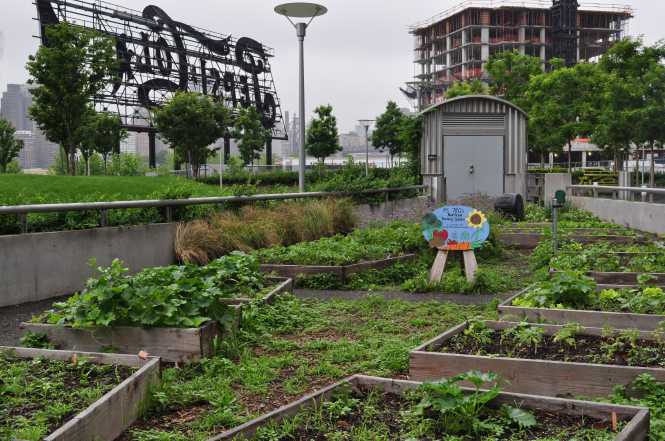
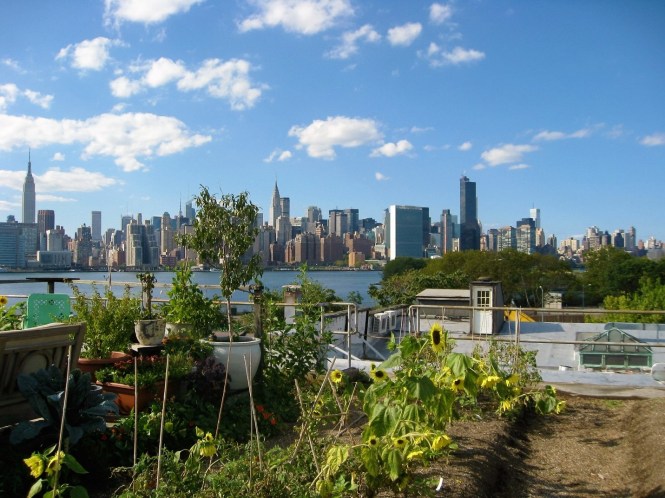
Rooftop Farm in Brooklyn, NY. Photo by Rositsa Ilieva.

Bridging community food systems and urban planning matters, now more than ever. Over the past fifteen years, more than 100 scholarly publications on the topic have appeared in architecture and urban planning journals worldwide and over 90 local food systems strategies have been released by local administrations in the Global North alone. On October 15, 2015, the first international urban food policy agenda – the Milan Urban Food Policy Pact – was signed by more than 100 cities and set a precedent, charting a new avenue for sustainability-minded planners. Unsurprisingly, thus far, research has not kept the pace with these innovations, leaving many opportunities untapped and the limits and promises of urban food planning insufficiently understood.

Against this backdrop my research, and my new book “Urban Food Planning: Seeds of Transition in the Global North” (Routledge, 2016), seek to lay the groundwork for urban food planning scholarship and practice from a global perspective. A central goal of this endeavor is to systematically assess and celebrate the emergent food systems planning initiatives and support the work of an increasing number of researchers, community advocates, and policymakers striving to advance sustainable cities and community food systems in tandem. To this end, I examine emergent urban food planning innovations through the lens of theories of sociotechnical transitions which enable me to discern the nonlinear dynamics of socio-spatial change and identify levers that can help steer future urban and food systems transitions. While the boundaries of the field are still in the making, it is fair to say that it encompasses both efforts to facilitate alternative practices, like urban agriculture and shopping at farmers markets as well as efforts to address anomalies in the mainstream food system, such as unequal access to fresh food retail, disproportionate urbanization of prime agricultural land, wobbly disaster preparedness of food distribution and transportation networks, and inefficient or nonexistent organic waste recycling infrastructure.

The practitioners behind innovative urban food planning practices are a broad constituency of urban food policy “entrepreneurs” having the common goal to make the urban food system work in the public interest to generate healthy, prosperous, and ecologically sound human settlements. Urban planners are just one group of practitioners across the many private practice professionals, activists, and government officials from a wide range of economic sectors and disciplines at the forefront of its development. Planners have, however, played a key role in advancing the urban food planning agenda by developing dedicated policy guides on the subject, creating working groups in their professional and academic associations on both sides of the Atlantic (e.g., the Food Interest Group of the American Planning Association [APA-FIG] in the US – the authors of this Blog, and the Sustainable Food Planning group of the Association of European Schools of Planning in Europe), and popularizing the topic through scientific journals, books, and academic conferences.

The evidence shows that urban food planning has grown into a new niche for social innovation, research, and practice and there are plenty of reasons and unique opportunities for planners to make a difference, while doing what they already do, only better. Planners who see food as priority in their work are still a minority, however, the public understanding that food is an urban system and that ensuring its sustainability is part of the responsibilities of local governments, in both developed and developing counties, has started gaining prominence over the past decade. In “Urban Food Planning,” I argue that there are at least 10 good reasons why now, more than ever, it is in planners’ interest to engage with urban food planning. Among these, are a rapidly expanding food systems planning community of practice to work with, a rising demand for expertise in urban food planning from both public, private, and civil society sectors, the potential for increasing the legitimacy of planning interventions, and the new Sustainable Development Goals (SDGs) mandated by the UN 2030 Agenda for Sustainable Development.

Urban food planning – the bundle of government, business, and civil society practices aimed at building sustainable cities and food systems in tandem – is a “hybrid” social niche in-the-making, encompassing a host of creative conceptual, analytical, design, and organizational responses to fundamental questions such as: What’s wrong with the urban food system? Why should we care? How do we fix it? and Who is in charge? In fact, urban food planning is both a distinct practice and a bundle of place-based practices (e.g., community food security assessments, mapping existing and potential sites for urban agriculture and current demand, conducting regional foodshed analyses, devising comprehensive food systems strategies and plans, among many others). Local government provisions, such as zoning and financial incentives for fresh food stores, bans on fast food outlets in school districts, removal of building code barriers for rooftop greenhouses, or reducing restrictions for onsite processing and selling of produce, are also part of the bundle. Thus, differently from other niches for social innovation, like the UK-based Transition Towns movement for instance, urban food planning novelties stretch beyond the circles of citizens’ groups and community advocates alone.

Each practitioner involved in urban food planning possesses distinct strengths and competitive advantages to advance the global Agenda for just and sustainable food systems. Beginning to map and recognize such strengths, alongside the obvious limitations of working in a niche, is a task that needs to be timely addressed. One of the biggest challenges in trying to map a transition process in its early stages of development, however, is that the speed of change is such that by the time one takes a snapshot of a fragment of the system, the entire landscape has already changed – some novelties have died out, others have moved on, and new ones have emerged. This can be frustrating for the academic investigator, let alone the planner practitioner or the policymaker, seeking to legitimize their research, long-term plans, or policy recommendations. Yet, as food systems planner Martin Bailkey recently put it, not being able to keep up with the pace of innovation in the field is “a good challenge to have.”

A more stable suite of urban food planning practices has the potential to transition urban food planning from an unstable niche to a robust social innovation in the position to challenge incumbent planning and food system regimes, helping local governments and communities to pursue a “bolder vision for the city.” Strategic levers for change include opportunities to strengthen present endeavors to represent, understand, and transform the urban food system, as well as to legitimize city-level interventions in the public domain, but also to question its current assumptions and ideologies. In fact, as the narrative of the book cruises through different food planning novelties, the reader is cautioned that there is nothing inherently good in a new practice per se, nor there is anything inherently sustainable in the scale at which practices are carried out, however, both new ideas and local actions are fundamental in imagining and enacting societal transitions. And we, planners and allied professionals in the Global North, have the moral obligation to be at the forefront of this institutional and environmental transition.

Finally, the focus of “Urban Food Planning” is on experiences from the Global North, not because food systems planning innovations do not manifest in developing economies regions – in fact, they greatly do, but because the impact of rich cities on their local and global hinterlands is so extensive and, at the same time, so scarily well concealed, that every effort to address it offers a rare chance to break the myth that we are living in a benign and harmless cornucopia. Only by making visible and by appreciating the critical mass of city-regional food system innovations, taking place in our own backyards, can we debunk the delusion that food is working in the public interest and it is superfluous in sustainable urban development projects and strategies in wealthy states. The goal of integrating local food infrastructures in and around cities has been in urban planning’s DNA since its inception, but for over a century it has remained suppressed for cultural, political, and economic reasons. There has hardly ever been a better time to restore it.

By:

Rositsa T. Ilieva, Ph.D.
Milano School of International Affairs, Management, and Urban Policy
Parsons School of Design
The New School, New York, NY 10003
E-mail: ilievar@newschool.edu
@RositsaTIlieva, LinkedIN: www.linkedin.com/in/rositsa-ilieva-73236016

Meet up with APA-FIG at the National APA Conference May 6-9, 2017!

APA-FIG is excited to host a reception and annual meeting on May 8 at the conference – a chance for FIG members and other interested in food system planning to meet, mingle and get involved in FIG. Here’s a sneak peak of the food system sessions happening: Incentivizing the Sale of Healthy and Local Food; Incentivizing the Sale of Healthy and Local Food; Growing Food Connections for Community Change; Developing Vermont’s Food System through Planning; Safe, Active Routes to Healthy Food. If you come early, check out the mobile tour on May 5—Hudson Valley Local Agriculture and Foodshed. To learn more and register, visit https://www.planning.org/conference/.