Current Role: Sustainability Intern, Salt Lake City Sustainability Department
What’s your favorite food?
Pizza. I spent my entire childhood hating it because of my wariness of thick patches of dubious sauce on the Little Caesars pizzas my family always got, but as an adult it has become the thing I’d be happy to eat for most meals, even breakfast (in the form of leftovers of course). I love it so much that this year when I was proposed to, I then proposed we go get pizza to celebrate.
What do you enjoy about your work?
Before I went to school to become a planner, and before I embarked on this big food mapping project for Salt Lake Sustainability, I was a journalist. I primarily wrote about music, culture, and eventually food, and it was both what I enjoyed and what I got bored of in journalism that led me to pivot. I really love digging into a pile of information and finding where everything fits together to make a cohesive story—like putting a puzzle together. I really came to dislike the same-ness of the work. I chose planning because of the many different projects you can work on in any given role, and the many different tools you need to build a project.
I’ve been with the Sustainability Department for a year and four months, with my internship extended to accommodate my work on a Food Environment Map of Salt Lake City and a subsequent report. In that time, I’ve worn many hats; policy research and briefing, report-writing, survey creation and analysis, making maps and analyzing them, as well as helping organize outreach around our Climate Plan. This kind of variability—juggling short-term projects with the kind of projects that stretch a year into the future—is what I wanted, and keeps me on my toes. I particularly enjoy helping figure out how different projects can communicate usefully with one another; like how food systems work fits into our department’s climate planning work.
What do you find challenging about your work?
While planning practices in other cities seem to be embracing food systems as something the government has a role in stewarding, Salt Lake City is definitely not on that wave yet. Our biggest issues are air quality, a housing crisis, and a seemingly ever-worsening drought—our Great Salt Lake is shrinking. Planning around these is important; they’re among Maslow’s physiological needs. But so is food. Our food crisis is quieter than the other three, but no less concerning: we produce less than 2% of our own fruits and vegetables, import most of our food, and use much of our remaining farmland to grow alfalfa for cattle. And Salt Lake City’s development has been antagonistic to food production. For decades, the farmland around our formerly agrarian city has been given over to development.
Perhaps the most frustrating part is how conversations about Utah’s remaining farmland frame the water-use problem: that water would be better put in the savings bank of the Great Salt Lake, and then maybe also put to (supposedly less intensive) urban development. But growing less water-intensive crops for people instead of cattle feed could be a more sustainable use of water and could also improve our supply of regionally produced food.
Whether they live in a city or a rural area, most people, including those who work in local government, think of food as coming from “somewhere else.” And since city folk often think that “somewhere else” ought to be out in the country, it’s doubly hard to shake the idea that urban agriculture is just cute community gardens rather than infrastructure we need to invest in to stabilize our environment and our future. This blind spot makes it really hard to argue that (regenerative, locally adapted) agriculture, in cities and outside them, is a vital investment in our cities’ stability in a climate-strained world. It’s also integral to sustaining soil health and the land’s resilience to floods, droughts, and heatwaves.
What areas of the food system do you encounter or focus on in your work? Where does food fit in with the rest of the work that you do?
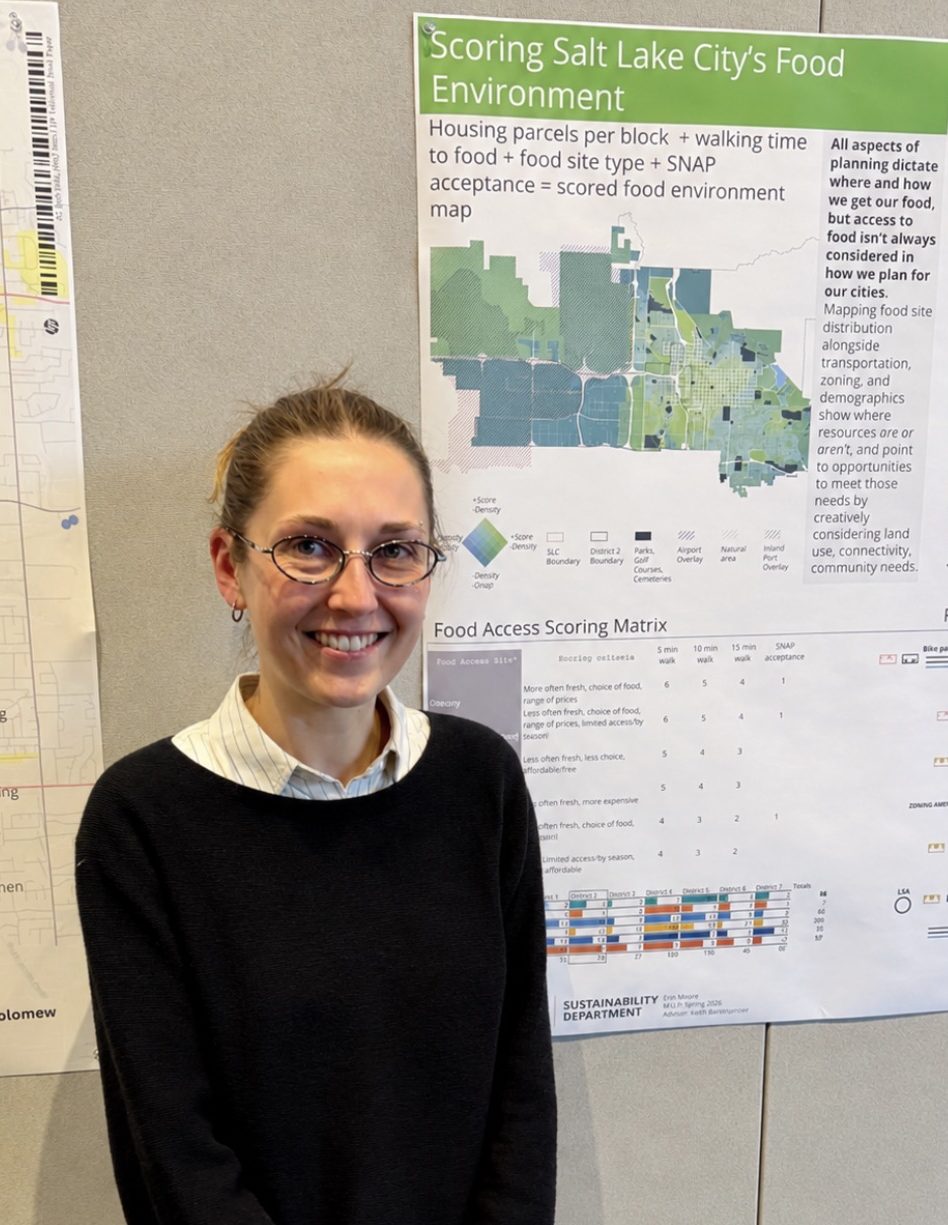
So far, most of my work has been my Food Environment Mapping project, which took the better part of the last year and a half to create. It visualizes where food access sites are in the city, how they’re distributed (accessibly? clustered together?), and how do people get to them (walkable? close to transit or bikeways?). It also uses survey data to explain how people interact with those means of access. So right now, my work mostly touches on food production, preparation and consumption, and markets and purchasing.
In the report that breaks down the map and survey findings, I advocate for protecting land for food production, especially in one of our local “agrihoods.” I also advocate for cities to invest in, support, or incentivize more neighborhood markets where people want them, instead of most of the food being located along busy, car-centric corridors, as it is now.
These arguments fit well with other work the food systems program and I do in the department. Our climate plan doubles down on the city’s air quality goals (SLC has horrible air), and making food more accessible via public and active transportation routes can help meet them. Urban agriculture can also help maintain green and open spaces with healthy soil that retains water and doesn’t give way to floods or add to fire risk. We can have parks and urban agriculture in the same spaces. My report showed an overwhelming desire among residents of our dense urban core for more community gardens, even though they already have more than other parts of the city. So why shouldn’t we kill two birds with one stone and tackle downtown heat islands with the green rooftop gardens and garden-centric apartment plazas residents want so much?
Do you consider yourself a food systems planner? Why or why not?
It’s hard to say what I am right now. Sometimes I feel so steeped in my Food Environment Map project, and the ways we’re connecting it to work in other city departments, that I feel I should claim that title. But as an intern without many local full-time job prospects in food systems, I don’t know if I’ll get to claim it any time soon. I’ve been applying to any planning-adjacent jobs with a climate planning or land use focus, but in Utah there really isn’t much planning work that has anything to do with food. And it’s pretty unlikely that I’ll leave Salt Lake City any time soon. Whatever full-time work I find after this internship, I’ll stay involved in food systems issues, even if it just means volunteering with local food orgs and staying in the loop through the APA Food Systems Division. My long-term goal is definitely to find my way back to food systems planning and call myself a food systems planner one day.
What is the biggest food systems planning-related hurdle your community/organization faced in recent years and how was it dealt with?
I can’t speak to the time before I joined Sustainability as an intern, but the food systems program has recently had to grapple with budget cuts. Most cities seem to be facing this, with everything so expensive in our country right now, and ours has responded by cutting a lot of “non-essential” programs. In my personal view, the cut our department just faced was a result of decision makers not understanding the value of our work, and especially how food security has gotten, and will keep getting, rockier with SNAP cuts, the Iran War’s impact on gasoline prices and on imports like fertilizer, and the coming El Niño, which is sure to devastate crops in the major production states Utahns rely on. So we’ve been discussing how to turn that around: how do we convince city decision makers that food systems are bound to, and as essential as, planning for housing, clean transportation, and smart water use?
What makes you successful in your work? What skills do you use the most in your food systems planning-related work?
I think I am good at holding a lot of projects on my plate at once and shifting priorities when need arises. Once I’ve landed on the most important task, I have a tendency to hyper focus on it. This kind of precision-thinking is useful when I am using GIS, which is the tool I use most often, probably second to writing and analysis. Both require going over data over and over again to see and explain patterns – the kind of work I love to do most.
What do you wish you would have known before going to planning school?
I wish I had known how hard it would be to do food systems work in a straight planning program… classes I hoped to take on land management practices and green spaces never materialized while I was in my graduate program, and I was left cobbling together a food systems planning study from electives outside of my department. But I didn’t realize, when I became interested in planning, how far flung food systems planning is from traditional planning practice, and that this interest of mine would grow into the most important thing that I wanted to study. I wish I had selected a more food systems-focused program somewhere else in the country, but as my dad would say, shoulda woulda coulda. It’s been comforting to meet other food systems planning people through APA who have had really similar experiences and un-linear paths into food systems work. It’s part of the reason I feel okay about how I probably won’t get to do “food systems planning” as a full time job any time soon, but if I keep my eye on the ball and keep incorporating food systems issues into whatever work I do end up doing full time, it will eventually materialize for me.
How has your perception of food systems planning changed since you first entered the planning field?
My annoying answer is that I just have more evidence to support my initial hunches, that we can and should be planning more intentionally in our cities, and that means integrating the food people need in all the places that it’s not. We need to maximize every kind of space to be sustainable, climate resilient, and useful to us—and for me that means integrating urban agriculture and much needed food processing, distribution, and waste management sites to fill the gaps that limit the growth of our current local food system.
Do you have any advice for someone entering the food systems planning field?
Get ready to explain yourself a lot!

