
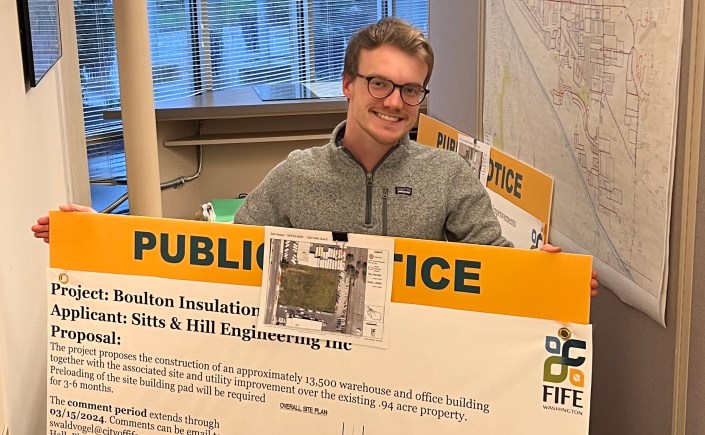
Name: Sebas Waldvogel – newly elected treasurer for APA FOOD. Sebas fills us in on supporting food systems advocacy with daily work as a municipal land use planner.
Current Role: Associate Planner – City of Fife, WA
What’s your favorite food?
These days I’m really working on making my best bagel. Maybe I’m just too tired (or lazy) to cook something more complex, but I really enjoy seeing how something simple can be elevated with a few additions.
What do you enjoy about your work?
It’s a little mix of everything! I’m a municipal planner, so I get to work on long range plans, regional projects, as well as permit review for current projects. It’s a great way to get a holistic look at development and policy in your jurisdictions. While maybe not the most exciting, I encourage everyone to look into their jurisdictions permitting process- from how your health department conducts food safety inspections to what types of restaurants are allowed within certain zoning designations.
What do you find challenging about your work?
More so the permitting side of things. My role is less of a food systems advocate and more of a food systems regulator. I work hand in hand with our building official, which has opened my eyes to the physical infrastructure requirements of food systems in urban areas. I think food is always in the room for the work I do, however it isn’t typically the focus.
Do you consider yourself a food systems planner? Why or why not?
Absolutely not. I wish I could, but I know I am a land use planner. What I do consider myself is a food systems advocate- land use planners have the potential to either support or condemn their local food systems, and the impacts to these local networks are something that we are making sure to acknowledge as we update our municipal code.
What is the biggest food systems planning-related hurdle your community faced in recent years and how was it dealt with?
We’re a pretty small city, dominated by industrial land uses and divided by freeways. We lost our grocery store in the early 2000s, and it became a common topic with our residents. We as a municipality were able to enter into a development agreement that allowed an existing business to expand their operations, in part by opening up a grocery store component of their new development. What has resulted is a Ukrainian Market, complete with a cafe that has quickly become one of the most popular attractions in the city. I think a lot of jurisdictions feel that they are victim to the market in terms of locating grocers, but we have more power than we think.
What makes you successful in your work? What skills do you use the most in your food systems planning-related work?
Beyond the baseline data analysis and GIS skills, I’ve found authenticity to be critical to success. Residents know when you’re rattling off prepared responses, and a project being run by a consultant with a city logo on it doesn’t land the same with residents. By establishing genuine connections with residents and local agencies, you are rewarded with direct and candid feedback. It may not always be what you want to hear, but it starts the dialogue centered around genuine thoughts and experiences.
Who has had the most influence on you as a planner? As a food systems planner?
I come from a long line of failed farmers. Going back generations, Waldvogel’s have tried to farm and have been incredibly bad at it. What resulted? A long line of agriculture supporting roles- a milk tanker driver, a farmland appraiser, an agricultural economist. This helped teach me that you don’t have to do something to support something. I can support food systems as a land use planner. While I have had many influential professors throughout my time at the University of Wisconsin-Madison, what has continued to inspire me as a planner and as a food systems advocate is the reminder that I don’t have to be in it to support it.
What do you wish you would have known before going to planning school?
Permitting. I know I sound like a broken record, but the permitting system is complicated and is a barrier for a lot of people. Transparency with the permitting process and having a general knowledge of these requirements has allowed me to be a better advocate for our residents. It’s easy to write policy and develop a proposal, it’s a lot harder to figure out how that actually gets approved through the existing regulatory processes.
How has your perception of food systems planning changed since you first entered the planning field?
I came from an agriculture background, and a lot of what I knew going into planning was centered around the producers. Recentering my concept of food systems on ease of access, access to programs, access to restaurants and grocers, access to information. That being said, I am a full time land use planner, so I am constantly learning from specialized planners across transportation, food systems, and housing.
Do you have any advice for someone entering the food systems planning field?
Ask questions! Of everyone. I’ve learned more about building code than I ever thought possible, and while I won’t lie and say it’s thrilling information, it has made me a better planner. Chances are most people’s work intersects with food in some way- all you have to do is ask about it.

