Special Guest Post from the North American Food Systems Network (NAFSN)
As a food systems lexicon continues to grow across academic, public, and private sectors, the practice of food systems work has taken shape. A focus on how individuals and organizations are doing food system work has developed. By supporting food systems practitioners, The North American Food Systems Network (NAFSN) works to illustrate the true breadth and depth of food systems work, across sectors, within all communities, applicable to everyone who grows, manages, teaches or eats food.
NAFSN is a new organization founded in 2015 offering leadership and technical skills training, networking, and other professional development opportunities for the burgeoning group of individuals supporting the development of equitable and sustainable local and regional food systems. Members range from farm educators and community nutritionists to justice activists and scholars. The mission of this network is to coalesce the current disparate group of practitioners, and build individual and collective capacity to solve pressing food and agriculture issues across the U.S. & Canada.
So how does that happen from all corners of the United States and Canada? Presently, there are many innovative solutions and pioneering organizations working to address and understand the complex issues of food systems; for example, working to eliminate causes of food deserts, obesity, hunger, and other food-related human health issues as well as working to increase sustainable farming practices, ecological and economic health of farms and rural areas, and creating viable markets. There is a need for a holistic collaboration and coordination between and among these efforts.
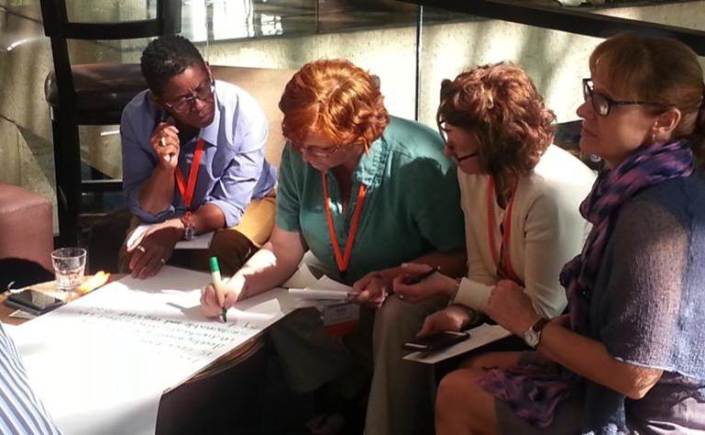
Leaders are needed to guide and propel projects and insights, and NAFSN aims to provide the tools to build the necessary human capital and create a place for sharing and collective learning. NAFSN expects to see growth of competencies, increased best practices, and more effective targeting of resources as results of its efforts. Currently, NAFSN members are organized around Circles that house work teams. Collaboration, skill and knowledge sharing, and mentorship have driven special projects from certification and training expansion, policy and governance building, and social media and communications development.
NAFSN Founding Members are currently working on projects specific to funding, racial equity and inclusion, and member networking. We’d love to hear from you! For more information about our national partner organizations, membership, and current projects check out our website: foodsystemsnetwork.org, or facebook: facebook.com/NAFSN, or e-mail: Membership@FoodSystemsNetwork.org