
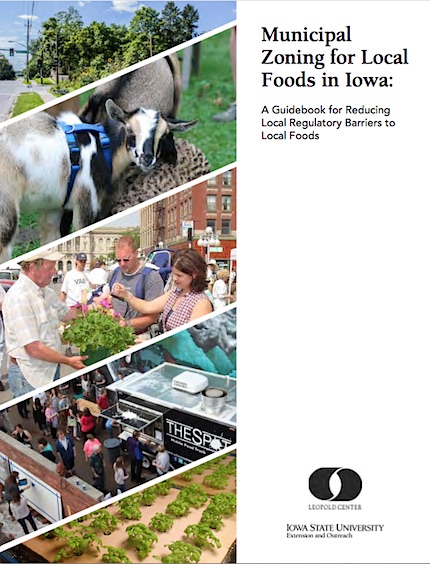
 Municipalities in Iowa and across the nation are increasingly recognizing the multiple benefits of urban agriculture; however, zoning regulations can unintentionally impede urban agriculture. To respond to this challenge the Leopold Center for Sustainable Agriculture at Iowa State University funded Gary Taylor and Andrea Vaage to develop the Municipal Zoning for Local Foods in Iowa guidebook. The guidebook provides science-based guidance and sample zoning code language designed to reduce the barriers to, and promote production and sales activities commonly associated with urban agriculture. Although written for Iowa, the guidebook contains practical information and code language applicable to any local jurisdiction.
The guidebook addresses the following common urban agriculture uses: aquaculture, bees, chickens, goats, front-yard gardens, community and market gardens, gardening on vacant lots, urban farms, season extenders, composting, Community Supported Agriculture (CSA) drop-sites, farm stands, farmers markets, food trucks and pushcarts, and urban agriculture districts. Each chapter provides a general description of the activity, and the science-based information on standards and best practices associated with the activity; the public health, safety and welfare concerns commonly associated with the activity; a summary of the commonalities found among municipalities’ codes; and sample code language taken from municipalities that vary both in size and location.
For more information, click here.

 Health Affairs is planning a theme issue on food and health in November 2015. The issue will present work that explores the relationship between the food we consume and our wellbeing on the individual, societal, and global levels. Articles will address causes and consequences of dietary excess and insufficiency, analyze policies and programs aimed at influencing these, and explore the roles of public policy, industry, and stakeholder groups in the context of dietary behavior. To be considered, abstracts must be submitted by midnight, EST, Monday, February 23, 2015. For more information, click
  APA FOOD